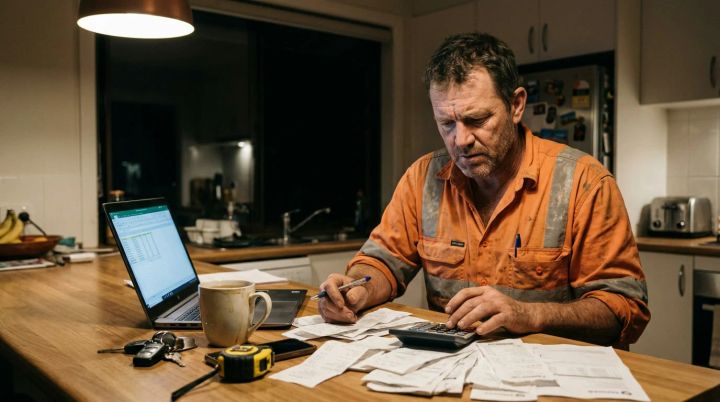

The BAS lands, the tax bill follows, and the money that should be sitting there went on timber, fuel and a new drop saw three months ago. You're not broke. You just spent the ATO's share without meaning to.
It's one of the most common cash traps in the trades, and it's easy to fix once you know the numbers. Here's how much to set aside for tax and BAS in 2026-27, when it's due, and a simple system so the bill never catches you short again.

Key Facts: Setting Aside for Tax and BAS
- If you're registered for GST, one eleventh of every GST-inclusive payment you receive belongs to the ATO, not you.
- Quarterly BAS is due on 28 October, 28 February, 28 April and 28 July. Lodging online can get you up to two extra weeks, except for the February quarter.
- For 2026-27, every dollar of taxable income between $45,001 and $135,000 is taxed at 30c, plus the 2% Medicare levy.
- A common rule of thumb is to set aside 25 to 30% of your profit for income tax, separate from the GST you collect.
- Once your tax bill reaches certain limits, the ATO puts you on quarterly PAYG instalments, so income tax becomes a quarterly bill instead of a once-a-year shock.
The Two Buckets: GST and Income Tax
The money you owe the ATO comes in two separate buckets, and mixing them up is where most tradies come unstuck.
GST (goods and services tax) is the 10% added to your prices. You must register once your GST turnover hits $75,000 a year. If you're registered, every GST-inclusive payment you receive has GST baked in: on a $1,100 invoice, $100 is GST. The quick sum is to divide by 11. You can claim back the GST on business purchases like materials and fuel, so what you actually pay at BAS time (your business activity statement, the quarterly form where you report GST) is the difference.
Income tax is worked out on your profit: what you earned minus your business costs, excluding GST. As a sole trader, your business profit is taxed at the same personal rates as a wage, plus the Medicare levy.
How Much to Set Aside for Tax in 2026-27
Here's what income tax and Medicare actually come to at different profit levels, using the 2026-27 resident rates. It assumes a sole trader with no other income and no tax offsets, so treat it as a guide, not your exact bill.
Yearly profit (taxable income) | Income tax | Medicare levy (2%) | Total | Share of profit |
|---|---|---|---|---|
$60,000 | $8,520 | $1,200 | $9,720 | 16.2% |
$90,000 | $17,520 | $1,800 | $19,320 | 21.5% |
$120,000 | $26,520 | $2,400 | $28,920 | 24.1% |
So why do accountants say 25 to 30%? Because you don't know your final profit until the year ends, a good quarter can push you into a higher bracket, and a buffer beats a shortfall. If the year finishes well under, the leftover is a pleasant surprise rather than a scramble.
One change to note: the lowest tax rate (on income between $18,201 and $45,000) dropped from 16% to 15% on 1 July 2026, and is legislated to fall to 14% from 1 July 2027.
When Tax and BAS Are Due
If you lodge your BAS quarterly, these are the dates to put in the calendar for the rest of 2026-27.
Quarter | Covers | Due date |
|---|---|---|
Quarter 2 | October to December 2026 | 28 February 2027 (a Sunday, so Monday 1 March). No online extension |
Quarter 3 | January to March 2027 | 28 April 2027 |
Quarter 4 | April to June 2027 | 28 July 2027 |
Quarter 1 | July to September 2027 | 28 October 2027 |
If you lodge online, you may get an extra two weeks for every quarter except the February one, which already has a built-in extension. Using a registered BAS agent can also give you more time.
PAYG instalments: paying income tax as you go
PAYG instalments (pay as you go) are the ATO's way of collecting income tax through the year instead of in one lump. You're entered automatically when your latest tax return shows instalment income of $4,000 or more, tax payable of $1,000 or more, and estimated tax of $500 or more. The instalments are paid with your BAS.
It feels like more tax, but it's the same tax, spread out. Heads up for newer businesses: your first tax bill and your first PAYG instalments can arrive close together, so set aside extra in your first couple of years.

A Simple System: The Tax Account
Open a second bank account and call it something you won't touch, like "ATO money". Then make it a habit every time a payment lands:
Move the GST. If you're registered, transfer one eleventh of the payment straight away.
Move your tax share. Transfer 25 to 30% of the profit on that job.
Pay the BAS and instalments from that account, and nothing else.
Do it on the day the money comes in, not at the end of the month. By the end of the month it's already been spent on something.
The Verdict: Should You Set Aside 30% Instead of 25%?
Do this if
- Your profit is heading past $135,000, where the rate climbs to 37c in the dollar
- You're in your first couple of years and not yet on PAYG instalments
- Your income comes in big, lumpy payments that are hard to predict
- You've ever been caught short on a BAS or tax bill before
Don't do this if
- Your profit is around $60,000 or less, where the real rate is closer to 16%
- You're already paying PAYG instalments every quarter and they match your income
- Your accountant has worked out a specific figure for you, because their number beats a rule of thumb
Tax and BAS FAQs
What percentage should a tradie set aside for tax?
A common guide is 25 to 30% of profit for income tax and Medicare. On the 2026-27 rates, a sole trader with $90,000 profit and no other income pays about 21.5%, so 25% leaves a sensible buffer. GST is extra and separate.
Do I include GST in what I set aside?
Keep GST in its own bucket. If you're registered, one eleventh of every GST-inclusive payment is GST. You'll owe that, less the GST you paid on business purchases, at BAS time.
When is the next BAS due?
For the October to December 2026 quarter, it's due 28 February 2027. That's a Sunday, so you have until Monday 1 March. There's no extra online extension for this quarter.
What are PAYG instalments?
Regular payments towards your income tax, made with your BAS. The ATO enters you automatically once your latest return shows instalment income of $4,000 or more, tax payable of $1,000 or more and estimated tax of $500 or more.
This article is general information, not tax advice. Your situation may differ, so check with your accountant or BAS agent.